Identity with XMTP
Connect your digital identity to XMTP to provide users with secure, censorship-resistant messaging.
XMTP makes it simple to take any digital identity and use it as the basis for private, end-to-end encrypted, quantum-resistant conversations in your app.
- What is identity? A cryptographically verified digital identifier (wallet, passkey, social ID, etc.) that can be linked to an XMTP inbox for secure messaging
- Why it matters: Enables secure, censorship-resistant communication while preventing lockouts and allowing users to unify multiple identifiers under one inbox
- How it works: Apps create inboxes, then add/revoke identity associations (wallets, passkeys, social IDs). Recovery is handled through a designated recovery authority.
- Future-proof: Open design supports any identity system (current: wallets, passkeys, World ID; future: Solana, Bitcoin, Bluesky, etc.)
Supported identities
XMTP is open by design. A single XMTP inbox can be associated with multiple identifiers, each cryptographically verified:
- Wallets → EVM addresses, smart contract wallets, ERC-4337 accounts
- Passkeys → device-native WebAuthn credentials (p256)
- World ID → proof of personhood
- Social IDs → ENS, Farcaster, Lens, Base handles
- Future networks → Bluesky, Nostr, BTC, Solana, or any identity you want to support
With XMTP, you don't need to build a secure messaging layer for your app. Just connect your identity system to XMTP, and provide your users with encrypted, censorship-resistant communication out of the box.
How identity works with XMTP
On XMTP, every user has an inbox, identified by a cryptographic InboxID.
That inbox can be linked to one or more identifiers through signed IdentityActions, defined in XIP-46.
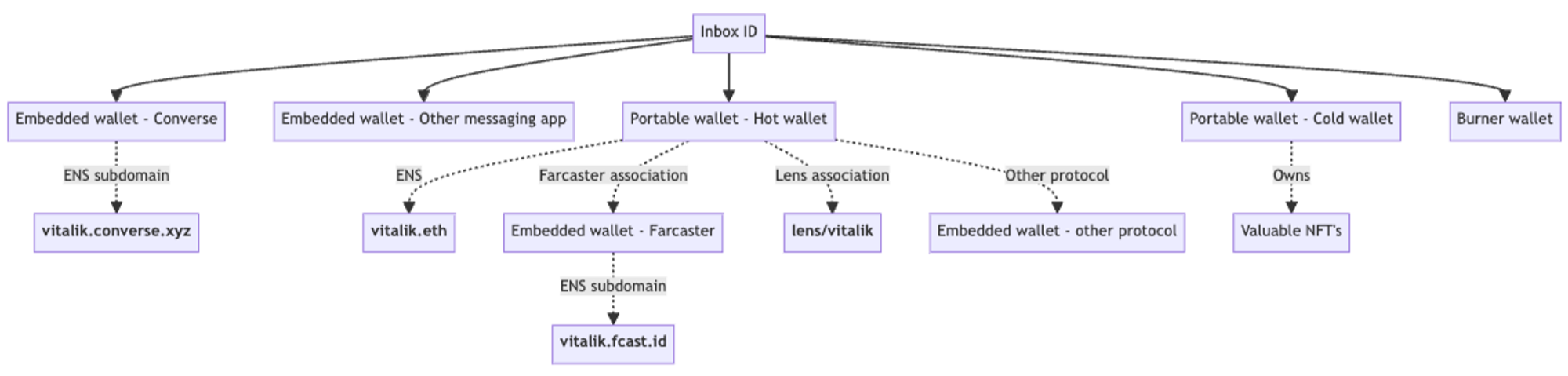
Below are the core technical concepts for creating, managing, recovering, and verifying identity with XMTP.
Manage identities with XMTP
Your app has complete control over how users' identities are connected to messaging. With XMTP, you can:
- Create → spin up a new inbox tied to a user's chosen identity
- Link → add additional identifiers (wallets, passkeys, social IDs) to the same inbox
- Recover → restore access if one identifier is lost or compromised
- Rotate → change or update the recovery authority that safeguards the inbox
Secure recovery for compromised inboxes
Each inbox has a recovery authority (e.g., a wallet or passkey) that can revoke associations or rotate control if another identifier is compromised.
- A designated identifier (e.g., wallet or passkey) with the ability to revoke associations or transfer recovery rights.
- Provides resilience if a linked identifier is lost or compromised.
- Prevents single-point lockouts.
Identity verification
- All associations are backed by cryptographic signatures.
- The XMTP SDKs verify proofs so apps don't have to implement their own crypto.
- Ensures identifiers cannot be spoofed or maliciously linked.
To learn more, see the full specification, code samples, and SDK references for building with XMTP identity.
XMTP identity roadmap
- Late 2025 → Decentralized identity coordination on the XMTP Appchain as part of mainnet launch.
- 2026 → Add more networks and identities like Solana, Bitcoin, and Bluesky.
Why XMTP
XMTP's mission is to increase the world's freedom to communicate.
By connecting your identity model to XMTP, you give your users a messaging experience that is:
- Secure by default → End-to-end encryption with MLS, forward secrecy, post-compromise security, and post-quantum protection.
- Private → Metadata protection ensures no one can see who is messaging whom, when, or how often.
- Resilient → Recovery authority prevents lockout and allows compromised identifiers to be revoked.
- Composable → Users can unify multiple identifiers (wallets, passkeys, social IDs) into a single inbox.
- Standards-based → Built on open cryptographic standards and XIPs like XIP-46.

